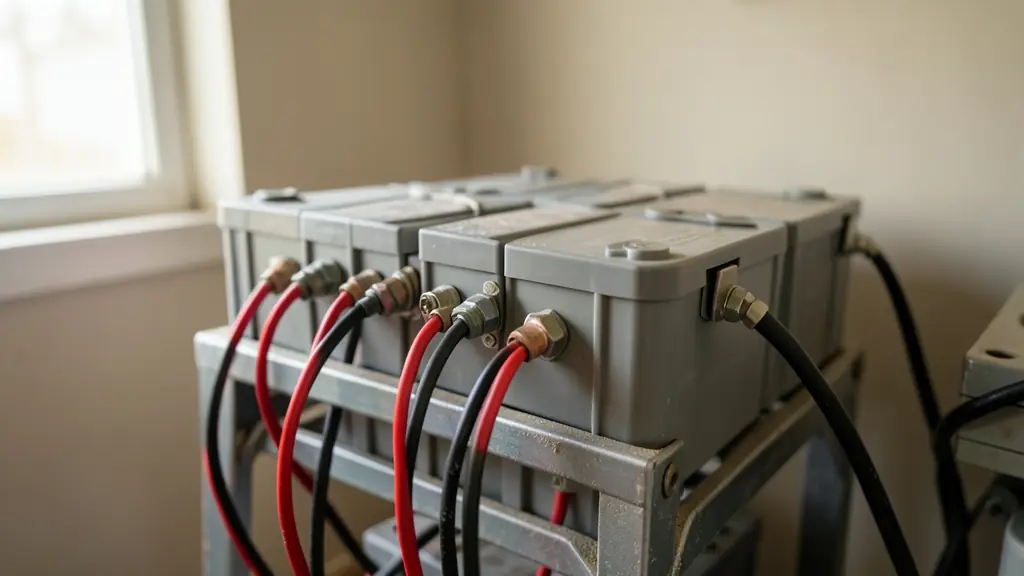
An inverter battery holds the energy the inverter hands out when the grid drops, and it sets how many hours the house keeps going. The inverter decides how much can run at once; the battery decides for how long. Most new systems use lithium iron phosphate, but lead acid and gel still turn up on older installs and tight budgets, and the differences go well beyond the price tag.
Price guideLithium (LiFePO4) batteries cost about R3,300 to R5,600 a usable kWh, VAT included, so a 5 kWh battery runs about R21,500 to R28,000. Installation and the COC are extraA rough guide from published South African prices. The area, the term, the grade, what is included and VAT all move it.
Lithium iron phosphate, lead acid and gel compared
| Lithium (LiFePO4) | Lead acid | Gel | |
|---|---|---|---|
| Usable capacity | About 80 to 90% | About 50% | About 50% |
| Cycle life | Many years of daily cycling | Short when cycled daily | Better than flooded, below lithium |
| Weight | Light for the energy | Very heavy | Heavy |
| Heat | Dislikes heat, managed by the BMS | Loses life fast in a hot garage | Also suffers in heat |
| Upkeep | None | Water top ups if flooded, gas venting | Sealed, none |
| Talks to the inverter | Yes, through the BMS | No | No |
kWh and how long a battery runs a load
A kWh is 1,000 W for an hour. A 5 kWh lithium battery gives about 4.5 kWh you can actually use, so a 500 W evening load (lights, TV, router, fridge) runs for roughly eight to nine hours, a little less after inverter losses. A 5 kWh bank of lead acid gives about half that before it should be recharged. Add a kettle and the hours fall fast. The battery backup calculator works it out from your load and battery type.
The BMS, matching and adding batteries later
A lithium battery has a battery management system (BMS) that guards each cell and, over a data cable, tells the inverter the state of charge. If the two do not speak the same language, the inverter guesses and the battery ages early, so check the inverter's compatibility list. Adding a battery later works best with the same model, voltage and a similar age. Never mix lithium with lead acid, and do not add a new lead acid battery to a tired old bank.
Where it goes, warranty and the old battery
Mount batteries somewhere cool, dry and ventilated: a garage wall or a utility room, out of the sun, off a floor that floods, and not in a bedroom. Lead acid gives off gas when charging, and a rack of it is heavy enough to need a solid wall or floor. Read the warranty: lithium terms come in years and in cycles or energy delivered, and running hot can void them. Old lead acid batteries should go back to the supplier or a scrap dealer for recycling, never into the bin.
Who asks for this
- Homeowners and tenants
- Enough stored kWh to carry the evening through two rounds of load shedding.
- Landlords and body corporates
- Batteries for a complex gate, intercom and passage lights that must never go dark.
- Builders and renovators
- A ventilated space and wall bracing planned for a battery rack in a new garage.
- Electricians and installers
- Lithium stock on account that matches the inverters an installer fits.
- Shops, offices and restaurants
- Hours of backup for tills, fridges and the alarm when an outage runs long.
- Factories, mines and plants
- Battery banks for server rooms, control panels and security systems.
- Farms and lodges
- Solar charged storage for a remote cottage, an electric fence or a borehole.
- Schools, clinics and municipalities
- A clinic or school office that needs a full working day of backup.
Frequently asked questions
Can I use a car battery as an inverter battery?
Not for long. A car battery is built for a short, hard burst to start an engine, not for being drained every evening, and it dies within months on daily cycling. Use a deep cycle or lithium battery.
Should I buy the battery and inverter together?
Often it is simpler. One installer then answers for compatibility, settings and the warranty, and the inverter price with battery is easier to compare across quotes.
How many years will a battery for a home inverter last?
It depends on how deep it is drained, how often, and how hot it sits. Lithium cycled within its limits lasts many years; lead acid drained flat every night may need replacing in one or two.
Do you sell batteries?
No. Backup power installers and battery suppliers close to you get the request and price it for you. Compare the usable kWh, the warranty terms and VAT on each reply.