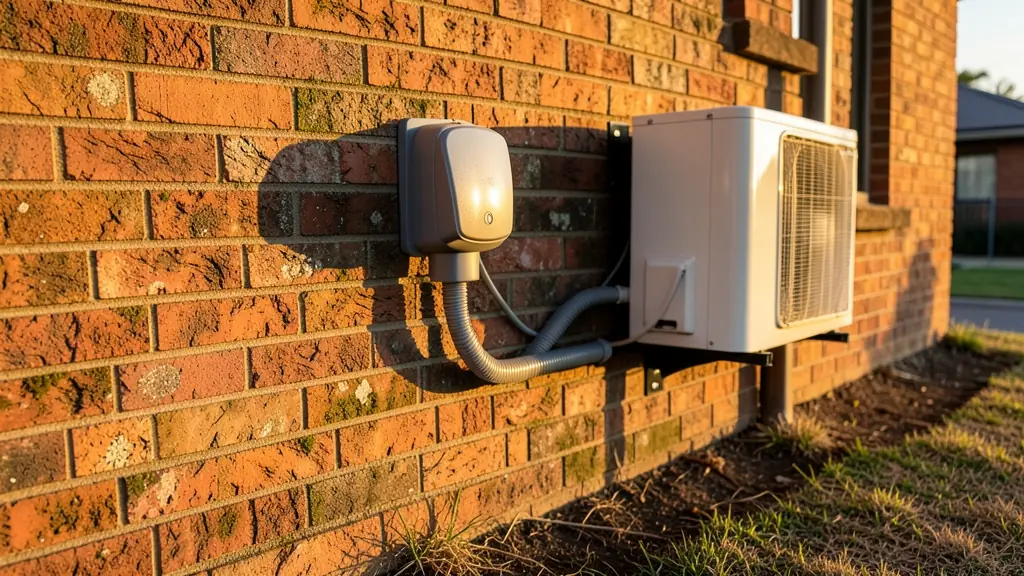
An isolator switch is a plain on and off switch that cuts one appliance off from the supply so someone can work on it safely. It has no trip and senses no fault: it just opens the circuit, often on both live and neutral. You find one beside the stove, in the ceiling near the geyser, on the wall next to an aircon unit outside, between solar panels and the inverter, and on the side of a factory machine.
Price guideAbout R123 to R155 for a 45 A or 63 A isolator and R200 to R243 for a stove or geyser isolator, VAT includedA rough guide from published South African prices. The area, the term, the grade, what is included and VAT all move it.
Isolator or breaker: what each one does
A circuit breaker in the DB protects the cable: it trips on overload or a short. An isolator only switches. The breaker sits in the DB board, which may be in a passage two rooms away; the isolator sits where the appliance is, so the plumber changing a geyser element or the technician regassing an aircon can see that it is off and keep it off. Many isolators can take a padlock in the off position for exactly that reason.
The common types, by job
- Stove isolator switch: a large wall switch above or beside the stove, commonly 45 A, often with a neon that glows when on.
- Geyser isolator switch: usually 20 A double pole, in the ceiling within reach of the geyser or beside the DB, sometimes added when a geyser timer goes in.
- Aircon isolator switch: a weatherproof rotary unit, IP65 or better, at the outdoor unit.
- PV isolator switch: a DC rated isolator between the panels and the inverter. An AC isolator is not a substitute: DC arcs do not go out the same way.
- Three phase isolator switch: a rotary switch on a pump, compressor or lathe, rated for motor loads.
- Battery isolator switch: on a bakkie with a second battery, a caravan or a boat, to stop a slow drain.
Rating it correctly
The isolator must carry at least what the breaker before it allows, so a 32 A stove circuit takes an isolator of 32 A or more, never a 20 A light duty switch that runs warm. Motors need an isolator marked for motor switching, because the starting current is several times the running current. Outside, check the IP rating and that the cable enters from below through a gland, so rain does not run into it. The breaker size calculator gives the current an appliance draws.
Who fits it
An isolator is part of the fixed wiring, so it is a job for a registered electrician, and it appears on the COC for that circuit. Buying the switch yourself is fine: get NRCS approved stock with the rating printed on it. A PV isolator is usually supplied by the solar installer as part of the system.
Who asks for this
- Homeowners and tenants
- A stove isolator for a new kitchen or a geyser isolator added with a timer.
- Landlords and body corporates
- Aircon isolators outside each unit so a technician never works on a live circuit.
- Builders and renovators
- Stove, geyser and aircon isolators on the second fix list for every house.
- Electricians and installers
- Boxes of 20 A and 45 A isolators on account for a run of units.
- Shops, offices and restaurants
- Isolators on the walk in fridge, the aircon and the shop's water heater.
- Factories, mines and plants
- Lockable three phase rotary isolators on pumps, compressors and machine tools.
- Farms and lodges
- Weatherproof isolators at the borehole pump and the cold room compressor.
- Schools, clinics and municipalities
- Isolators on school kitchen stoves, urns and aircon units for safe maintenance.
Frequently asked questions
Does a geyser need an isolator switch?
It is common practice to have a way of isolating the geyser close to it, and an inspector often looks for one. Ask the electrician what your installation needs; rules are applied to the house as a whole.
My stove isolator is hot to the touch. Is that normal?
No. Warmth usually means a loose terminal or an undersized switch. Switch the stove off at the DB and have an electrician look at it before the next Sunday roast.
Can I use a normal light switch to isolate the aircon?
No. A light switch is rated for a few amps indoors. An aircon needs an isolator rated for its current, and outdoors one with a proper IP rating and cover.
How is an isolator switch priced?
Per item. The price moves with the current rating, the number of poles, AC or DC, and whether it is weatherproof. Installation and the COC are quoted separately by the electrician.
Related topics
Work it out first
- Cable size calculatorLoad, length, phase and how the cable is run in: the cable size in mm² and the voltage drop out
- Breaker size calculatorAppliance watts or amps and the supply in: the current, the breaker rating and the cable usually used out
- Inverter size calculatorThe appliances that must run in an outage in: the running load, the peak when motors start and the inverter kVA out