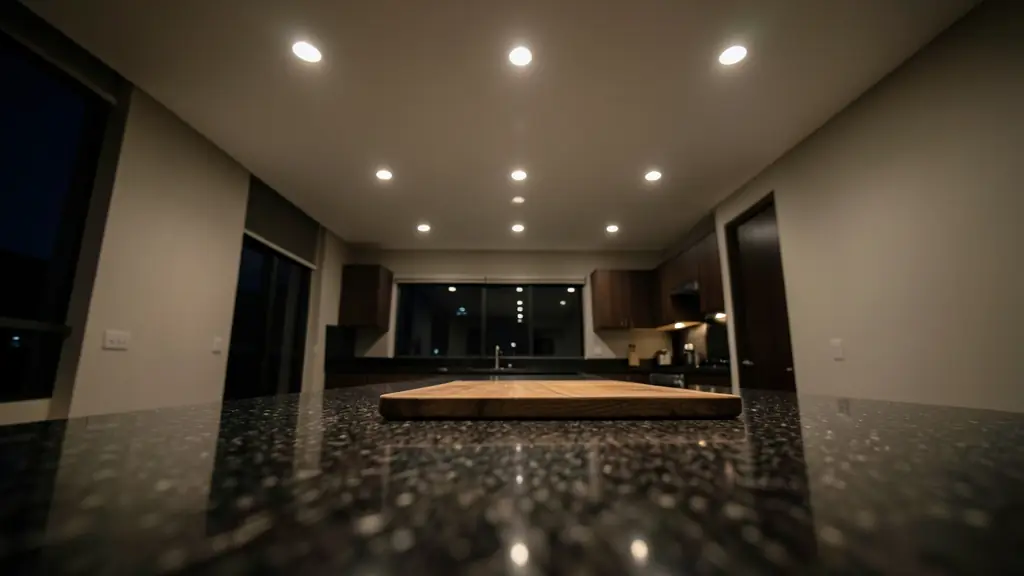
LED downlights are the small round lights set flush into the ceiling, and in most homes they have taken over from the halogen fittings that used to scorch the ceiling boards. Buying them looks easy until you stand at the counter: a GU10 lamp or an integrated fitting, 5 W or 9 W, 3000 K or 4000 K, which cut out, dimmable or not. This page sorts those choices so what you order fits the holes, the dimmer and the room.
Price guideAbout R35 to R123 for a 5 W or 7 W LED downlight, VAT included. Fitted by an electrician, expect about R250 to R550 a lightA rough guide from published South African prices. The area, the term, the grade, what is included and VAT all move it.
GU10, MR16 or an integrated LED downlight
- GU10 is a mains lamp with two stubby pins that twist into a fitting. When it dies you change the lamp, not the fitting, and spares are sold at almost every counter.
- MR16 is the old 12 V lamp with two thin pins, fed by a small transformer above the ceiling. LED MR16s on a halogen transformer are a common cause of flicker, so many electricians take the transformers out and convert the fittings to GU10.
- Integrated downlights have the LED and the driver built in. They are slimmer and often run cooler, but the whole fitting is replaced when it fails.
Lumens, colour temperature and beam angle
Compare lumens, not watts. A 5 to 7 W LED gives roughly 400 to 600 lumens, about what a 50 W halogen did. For colour, warm white (2700 to 3000 K) suits lounges and bedrooms, cool white (about 4000 K) suits kitchens, garages and offices, and daylight (6000 to 6500 K) is for workshops and shop displays. Keep one colour per room; a mix of 3000 K and 6500 K looks like two different houses. A narrow beam picks out a painting or a counter, a wide beam washes a whole room. The downlight calculator works out how many you need and how far apart from the room size and the lumens.
LED downlights and dimmers: why they flicker
The usual story: new LED lamps go in, the old dimmer stays, and the lights buzz, flicker or will not go low. An old halogen dimmer needs a minimum load that a few LEDs never reach. You need two things together: lamps marked dimmable and a dimmer made for LED loads (see light switches). Cheap drivers can flicker even with no dimmer at all; point a phone camera at the light and a banded picture gives them away.
Bathrooms, the cut out and the wiring
Above a shower or outdoors under the eaves, ask for an IP rated fitting such as IP44 or IP65. In a flat or a double storey where the ceiling is part of a fire barrier, ask about fire rated fittings. Measure the existing holes before you order: a smaller fitting leaves a gap, a bigger one means cutting every hole wider. Swapping a lamp is a homeowner job with the switch off. New fittings, moved points or an extra lighting circuit are fixed wiring: book a registered electrician and get the COC for it.
Who asks for this
- Homeowners and tenants
- Swapping scorched halogens in the lounge and kitchen for cooler LED lamps.
- Landlords and body corporates
- The same fitting in every flat so spares are simple and tenants stop complaining.
- Builders and renovators
- A lighting layout and a count of fittings for each room of a new house.
- Electricians and installers
- Boxes of matching downlights on account for a complex of townhouses.
- Shops, offices and restaurants
- Even, bright light over shop shelves and a counter without hot spots.
- Factories, mines and plants
- Offices and canteens beside the plant, where high bays are not needed.
- Farms and lodges
- A farm stall, a lodge dining room or a guest cottage ceiling.
- Schools, clinics and municipalities
- A school hall or clinic passage moving off old fluorescent tubes.
Frequently asked questions
Can I put LED GU10 lamps into my old halogen fittings?
Usually, if the fittings already take mains GU10 lamps. Look at the lamp holders first: years of halogen heat leave them brown and the wires brittle, and those are better replaced by an electrician.
How long do LED downlights last?
Packaging often claims tens of thousands of hours, but the driver and the heat decide. A decent fitting with room to breathe lasts many years; a cheap one in a closed, insulated ceiling may go in two.
Why do my downlights glow faintly when they are switched off?
A small current is reaching them, often through a dimmer, a smart switch or a switch on the neutral instead of the live. It is a wiring question, so ask an electrician to check it.
Do you sell downlights?
No. Your list goes to lighting suppliers, wholesalers and electricians nearby; each prices the fitting and lamp type, and says if fitting them is included.