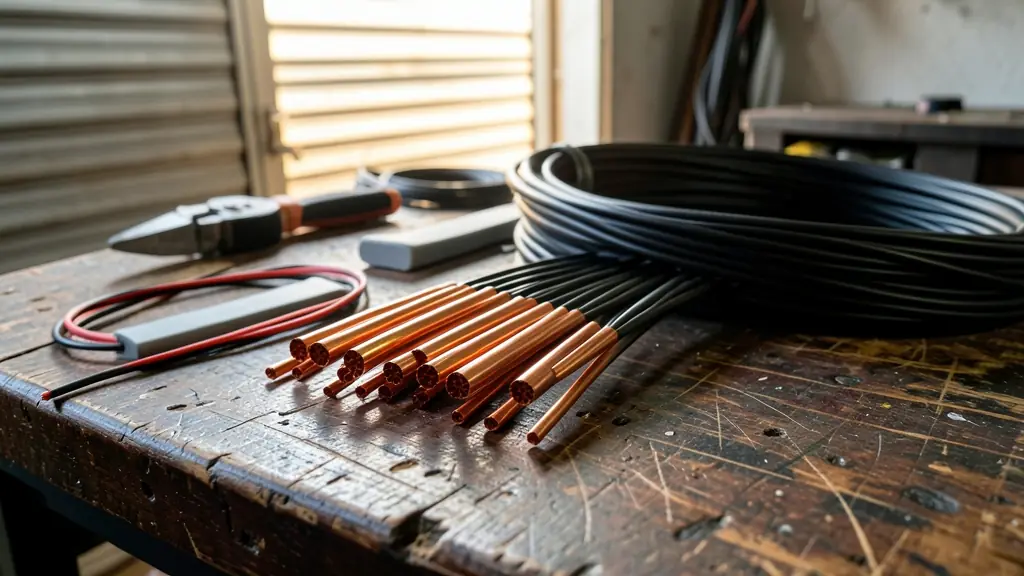
A cable size calculator answers two questions at once: will the cable carry the current without overheating, and will enough volts arrive at the far end? The thin cable that works for a plug next to the DB can be wrong for the same load at the bottom of the garden. Use it before you price electrical cable, so the quote is for the right size.
What to type in
Give the load in amps if you know it, or in kW with a power factor (1 for a heater or geyser element, about 0.85 for a motor). Measure the length one way, from the DB or sub board to the load, along the route the cable will really take, up the wall and over the ceiling. Pick the supply, 230 V on one phase or 400 V across three, and the way it runs: house wire in conduit in a wall, surfix clipped to a surface, or armoured cable buried in the ground.
How it chooses the size
Each size has a current rating, which falls when the cable is closed in. The tool takes published ratings for copper PVC cable and cuts them back for conduit and for clipped runs, so it leans to the safe side. Then it works out the drop: a figure in millivolts per amp per metre, times the current, times the length. The answer is the smallest size that passes both tests. A common design limit is 5% of the supply voltage, about 11.5 V on 230 V.
Two examples: 20 A over 30 m in conduit lands on 2.5 mm², dropping about 4.7%. Double the run to 60 m and the drop decides it, so the answer jumps to 6 mm².
Long runs: cottages, gates and boreholes
Length catches people out. A cottage fed on 32 A from a house 40 m away needs about 6 mm² armoured cable, though 4 mm² would carry the current. A three phase borehole pump of 5.5 kW at 120 m works on 2.5 mm² four core SWA, but 1.5 mm² drops about 7%. Undersized cable on a long run shows up as dim lights, a pump that hums and will not start, and a hot joint in the draw box.
Before you buy
- Check the breaker suits the cable with the breaker size calculator; see circuit breakers.
- Ask for copper, not copper clad aluminium, and check the size printed on the sheath.
- Count the conduit too: a big cable may need 25 mm conduit instead of 20 mm.
Frequently asked questions
What size cable do I need for 20 amps?
For a short run in conduit, usually 2.5 mm² copper. Past about 30 m on 230 V the voltage drop climbs over 5%, so 4 or 6 mm² is often used. Put your own length into the tool.
Why does cable run in conduit get a lower rating?
Closed in, it cannot shed heat as well as cable in open air, more so with other circuits in the same conduit or in a hot roof. The tool uses a lower figure for conduit than for clipped cable.
Can I use this result without an electrician?
No. It is a guide for planning and pricing. A registered electrician sizes the cable for grouping, heat and the fault level, fits it and issues the COC for the work.
Do you sell cable?
No. We keep no cable in stock. Your request, with the size, the metres and where it must be delivered, goes to wholesalers and suppliers in your area, who send their own prices.
Read more
More tools
- Breaker size calculatorAppliance watts or amps and the supply in: the current, the breaker rating and the cable usually used out
- Inverter size calculatorThe appliances that must run in an outage in: the running load, the peak when motors start and the inverter kVA out
- Battery backup calculatorLoad in watts, hours and battery type in: the kWh of battery to buy, or how long a battery lasts out
- Generator size calculatorRunning loads, the biggest motor, the phase and the fuel in: the generator kVA and fuel per hour out
- Electricity cost calculatorAppliance watts, hours a day and the rand per kWh in: units and cost a day, a month and a year out
- Ohm's law calculatorAny two of volts, amps, ohms and watts in: the other two and the formulas used out
- Downlight calculatorRoom size, room type and the lumens of a light in: how many downlights, the layout and the spacing out