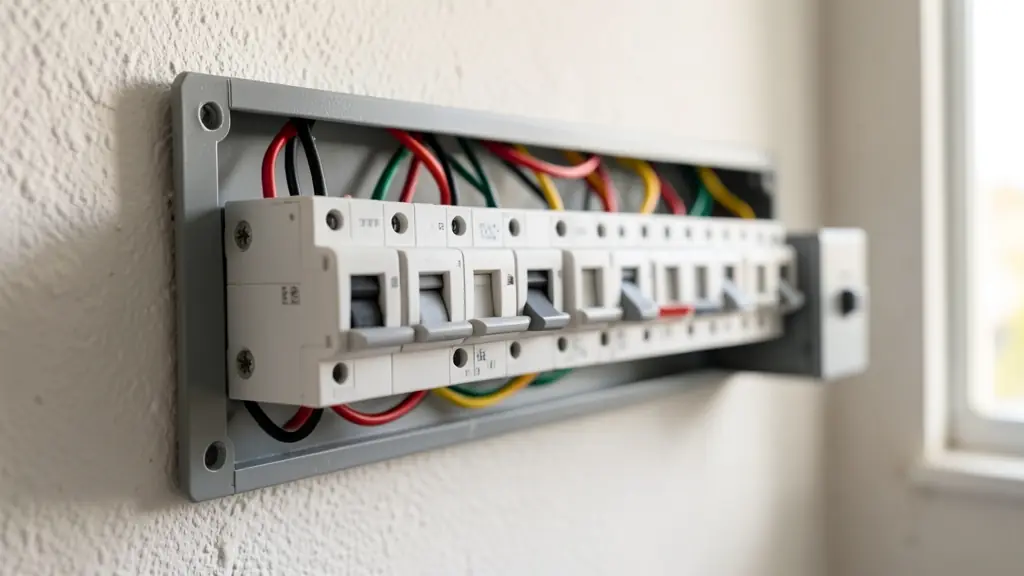
A breaker size calculator starts from the load and ends at a breaker and its cable. That order matters, because a breaker is there to protect the cable, not the appliance. Pick a geyser, a stove or a plug circuit, or type your own watts, and see which circuit breaker rating an electrician would usually reach for.
From watts to a breaker
Current is watts divided by volts. A 3 kW geyser element on 230 V draws about 13 A. A load that runs at full current for hours, like a geyser, a heater, a pool pump or an aircon, gets a quarter added so the breaker and cable are not held at their limit all afternoon: 13 A becomes about 16.3 A. The tool then takes the next standard rating up, here 20 A, from the usual list of 6, 10, 16, 20, 25, 32, 40, 50 and 63 A.
The cable that goes with it
For each breaker the tool shows the smallest copper cable whose rating in conduit is at least the breaker's: commonly 1.5 mm² on a 10 A lights circuit, 2.5 mm² on 16 or 20 A plugs and geysers, 6 mm² on a 32 A stove. That holds for an ordinary run inside a house. A long run, a cottage feed or a pump at the borehole may need a bigger cable for voltage drop, so check it in the cable size calculator.
When a breaker keeps tripping
A breaker that trips is doing its job: the circuit is overloaded, or there is a fault. Fitting a bigger breaker on the same cable only moves the weak point into the wall, where nobody sees the cable cooking. If the earth leakage trips rather than the breaker, look at the earth leakage page instead. Either way, a registered electrician finds the cause before anything is changed.
Buying the breaker
- Match the make and the clip to your DB board.
- Ask for a C curve breaker with the breaking capacity in kA that the board calls for.
- Buy only NRCS approved breakers; a fake may never trip.
Frequently asked questions
What size breaker for a 3 kW geyser?
Usually a 20 A breaker with 2.5 mm² cable; some electricians use 25 A with 4 mm². The geyser draws about 13 A; the extra allows for it heating for hours. The electrician decides on the day.
What breaker does a stove need?
A typical stove and oven is often on a 32 A breaker with 6 mm² cable, or 4 mm² on a short run. A large range with two ovens may need more. Check the stove's plate.
Is a bigger breaker safer?
No. A breaker rated above what the cable can carry lets the cable overheat before it trips. The breaker is always sized to the cable.
Do you supply or fit breakers?
We stock and fit nothing ourselves. Send one request and suppliers send prices for the breakers, or registered electricians quote to fit them and issue the COC.
Read more
More tools
- Cable size calculatorLoad, length, phase and how the cable is run in: the cable size in mm² and the voltage drop out
- Inverter size calculatorThe appliances that must run in an outage in: the running load, the peak when motors start and the inverter kVA out
- Battery backup calculatorLoad in watts, hours and battery type in: the kWh of battery to buy, or how long a battery lasts out
- Generator size calculatorRunning loads, the biggest motor, the phase and the fuel in: the generator kVA and fuel per hour out
- Electricity cost calculatorAppliance watts, hours a day and the rand per kWh in: units and cost a day, a month and a year out
- Ohm's law calculatorAny two of volts, amps, ohms and watts in: the other two and the formulas used out
- Downlight calculatorRoom size, room type and the lumens of a light in: how many downlights, the layout and the spacing out